
In his Sydney Morning Herald opinion piece of 6 November 2026, “Lighter policing is earned through trust. Lederer’s letter to Wanderers fans erodes it,” Darren Kane challenges Western Sydney Wanderers chairman Paul Lederer’s criticism of policing at recent A-League matches.
Kane argues that police deployments are based on intelligence-led risk assessments and suggests that Lederer’s public questioning of those decisions undermines the trust and cooperation necessary to maintain safety at football grounds.
There is no dispute that police have a responsibility to protect spectators, players and officials, or that intelligence plays an important role in determining appropriate security arrangements.
But the existence of a risk assessment does not automatically establish that every policing decision is reasonable or proportionate, nor should it place those decisions beyond legitimate scrutiny.
More concerning, however, is Kane’s attempt to justify his argument by drawing together three vastly different events — Heysel, Hillsborough and the abandoned Melbourne derby of December 2022 — in a manner that risks reinforcing precisely the stereotypes about football supporters that have caused so much damage over the years.
The comparison of the 2022 Melbourne derby pitch invasion with Heysel and Hillsborough in a Sydney Morning Herald commentary on football policing is not merely unfortunate. It raises serious questions about historical understanding, proportionality and the continuing tendency to portray football supporters as a collective public-order problem.
Nobody should defend what happened at AAMI Park on 17 December 2022. The assault on Melbourne City goalkeeper Tom Glover, the injuries to others and the abandonment of the match were disgraceful. Those responsible deserved to be identified and held accountable.
But that incident should not be casually placed alongside two of the darkest disasters in football history without acknowledging the profoundly different circumstances involved.
Hillsborough is particularly troubling in this context.
For decades, Liverpool supporters and the families of the 97 victims fought to establish the truth about the disaster. The 2016 inquests concluded that supporters were not responsible and identified serious failures in policing and crowd management.
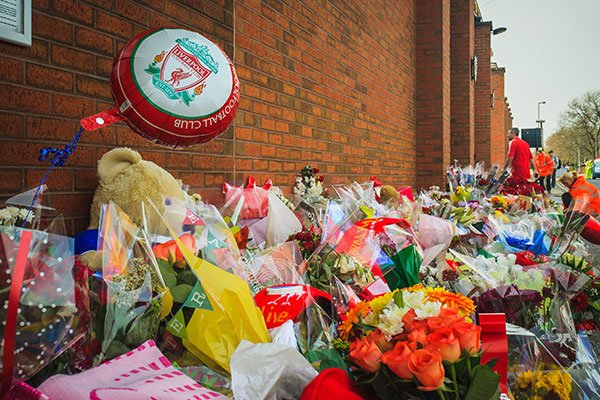
37 years on and the tributes still flow for the victims of Hillsborough
To invoke Hillsborough in an argument about the dangers posed by football crowds, without acknowledging those findings, risks perpetuating the very misconceptions that the families fought so long to overturn.
The issue is not whether football crowds require appropriate safety measures. Of course they do. The issue is whether those measures are proportionate, evidence-based and applied without prejudice.
Australian football supporters are not a homogeneous group.
The actions of individuals at one Melbourne derby cannot reasonably be used to characterise the thousands of supporters who attend matches peacefully, contribute to their clubs and help create the atmosphere that makes football distinctive.
Nor should the argument that lighter policing must be earned through trust be accepted without qualification.
“To invoke Hillsborough in an argument about the dangers posed by football crowds, without acknowledging those findings, risks perpetuating the very misconceptions that the families fought so long to overturn.”
Trust is a two-way responsibility. Supporters must respect the law and the safety of others.
Equally, police, stadium authorities, clubs and administrators must demonstrate that their decisions are fair, transparent and proportionate.
A safe football environment is not necessarily one with the greatest police presence. It is one where risks are properly assessed, dangerous behaviour is addressed, and supporters are treated as participants in a sporting community rather than presumptive threats to public order.
The media has every right to question supporter behaviour and challenge football administrators. Indeed, they should.
But that scrutiny must be informed by history, supported by evidence and careful not to reinforce damaging stereotypes.
Australian football supporters should be held accountable for what they do, not for what others have done, and certainly not through historically misleading associations with tragedies whose lessons deserve far greater care.
Football supporters deserve the same standards of fairness, proportionality and informed scrutiny that we expect in coverage of every other Australian sport.