Reimagining Australian Football: The Case for the A1/A2 Promotion & Relegation Blueprint
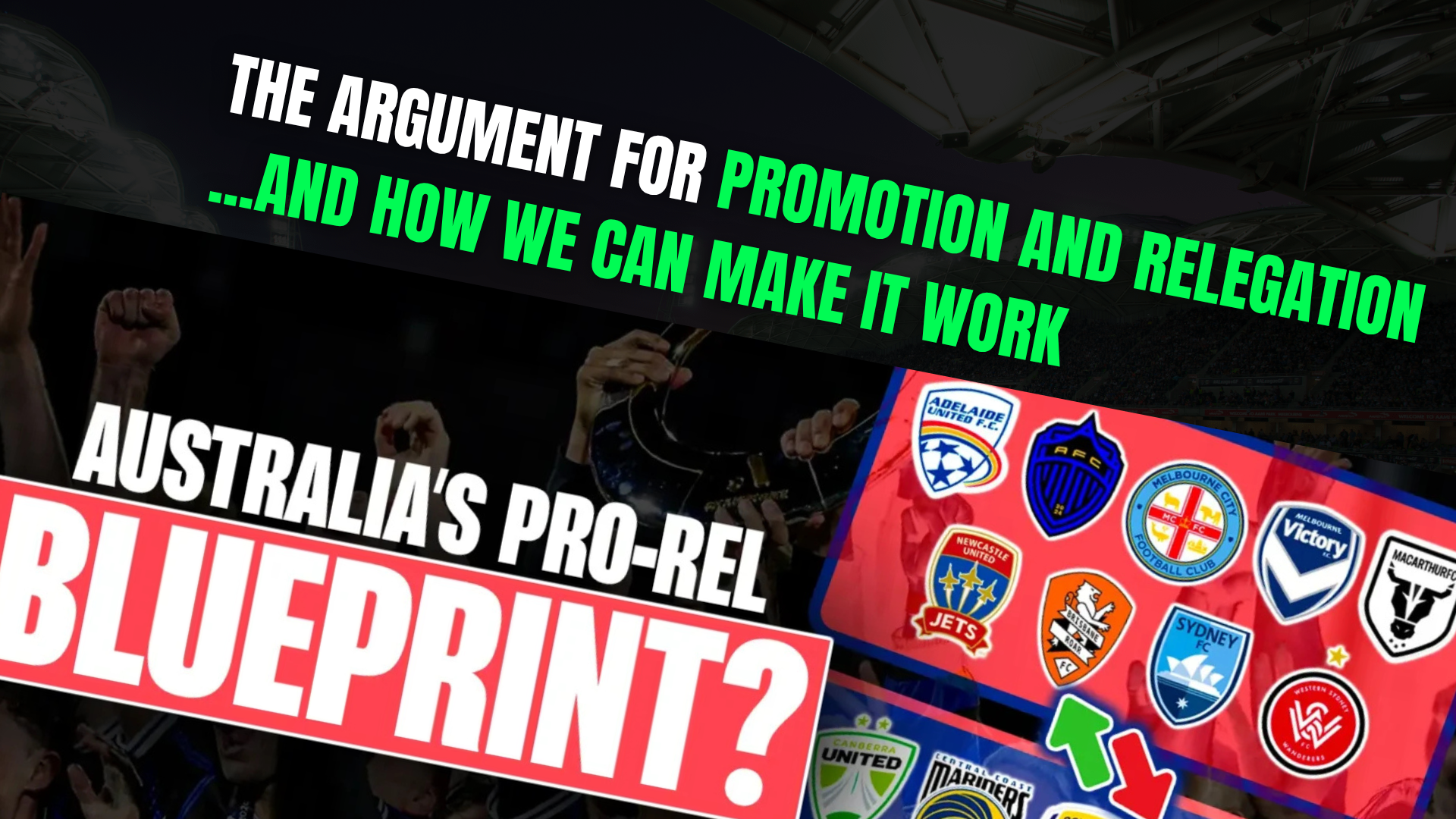
The atmosphere at the Australia Cup final between Melbourne Victory and South Melbourne offered an unmistakable reminder of the passion and untapped potential lying within the domestic game.
With a packed crowd and pre-match anticipation spilling out from Swan Street pubs, the spectacle proved that when meaningful narratives prevail, Australian football delivers an experience unlike any other sport in the country.
To explore how domestic football can systematically harness this energy, on Monday night Football Supporters Association Australia (FSAA) hosted a landmark webinar featuring Matt Windley, CEO of Bruce Media and host of the Building Blocks podcast.
As former chief football writer at the Herald Sun, former APL expansion lead involved in establishing Auckland FC, and author of a groundbreaking 161-page blueprint, Windley brings a unique and thought provoking perspective to this discussion.
The central thesis put forward by Windley is clear: Australian football cannot afford to stick the status quo.
The game urgently requires a sustainable, well-structured framework for restructuring the professional leagues, one that preserves the financial viability of existing professional clubs while establishing an aspirational pathway for historic and emerging clubs nationwide.
What is the A1/A2 Model?
At the core of Matt Windley’s proposal is the A1/A2 Model, a tailored structural reform detailed in his 161-page blueprint.
Rather than forcing promotion and relegation between the top-tier A-League and semi-professional state leagues, the blueprint introduces two connected professional divisions—A1 and A2—both owned, operated, and marketed under the unified Australian Professional Leagues (APL) banner.
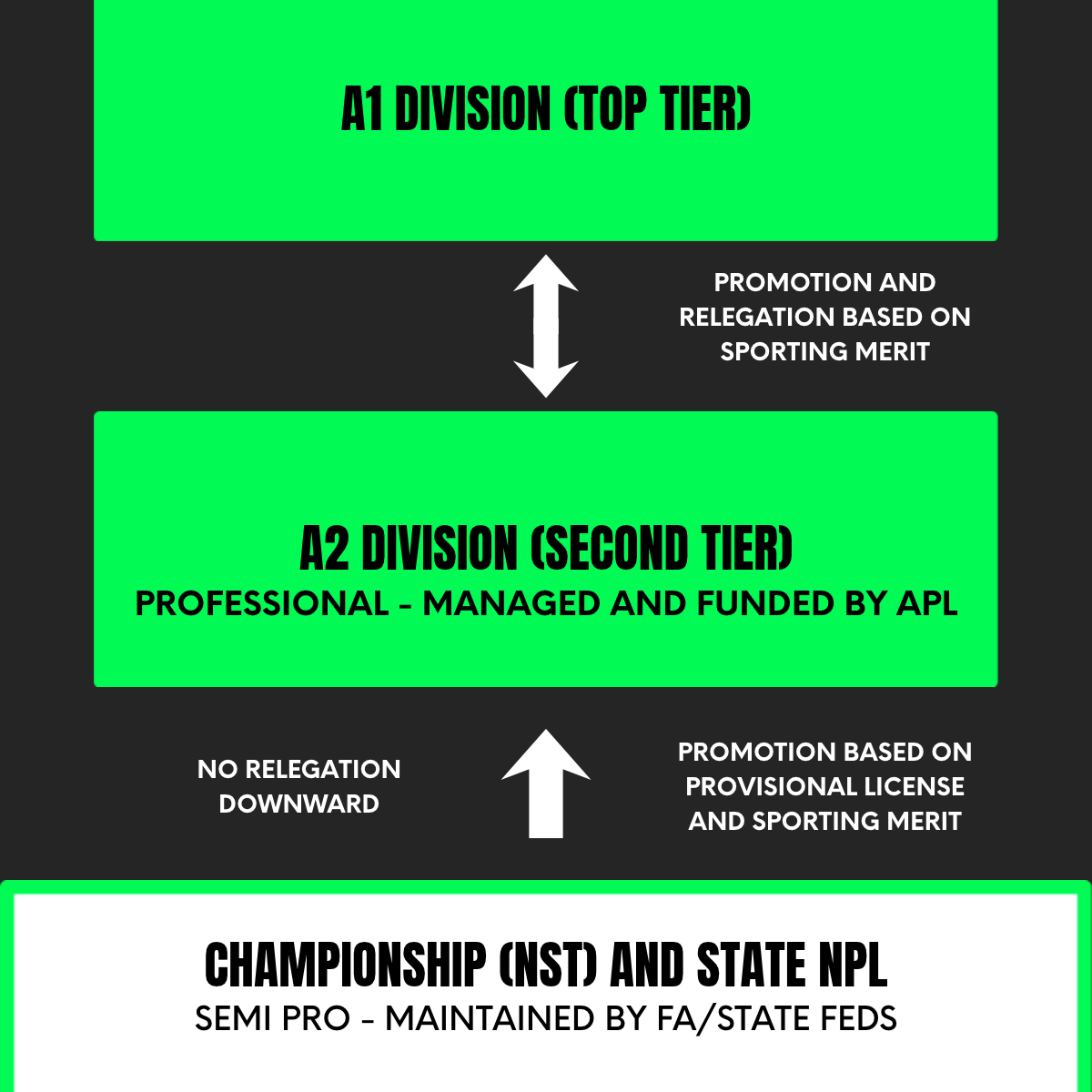
Key features of the A1/A2 structure include:
Professional Protection: Clubs competing in A2 maintain their professional license and unit holding within the APL structure. Crucially, A2 clubs do not face automatic relegation down to semi-professional National Premier Leagues (NPL) or regional competitions. This creates a "professional floor" that safeguards investments and prevents financial collapse.
Expansion Criteria & Associate Licenses: Aspirational clubs from the National Second Tier (NST) / Australian Championship or state NPLs earn promotion into A2 by winning on sporting merit and satisfying rigorous off-field benchmarks. Criteria cover corporate governance, financial turnover, stadium facilities, youth development pathways, and women's football programs.
Flexible Competition Formats: The baseline modelling begins with expanding the professional footprint to 18 teams, split into two divisions of 9. To maintain familiar derby matchups and broadcast inventory during transitional phases, the initial model incorporates home-and-away intra-divisional fixtures alongside cross-divisional crossover matches.
Debunking the Myths: Travel Costs vs. Reality
One of the most persistent arguments against implementing promotion and relegation in Australia is that the continent's vast geographical distances make travel expenses prohibitively expensive.
Windley’s blueprint addresses this argument directly through comprehensive financial modeling. By auditing every flight, bus transfer, and party size across various multi-division scenarios, the blueprint reveals that travel costs represent a minor fraction of overall operating expenses.
Total Operating Cost (18-Team A1/A2 Model): ~$40.0 Million
Broadcast Production Costs: $16.9 Million (~42% of budget)
Club Distributions ($1M for A1 / $500k for A2): $14.0 Million (~35% of budget)
Flights & Bus Transport Costs: $3.9 Million (<10% of total budget)
The financial modeling proves that travel is not the barrier holding back structural reform. Instead, broadcast production costs and distribution models represent the largest operational expenditures.
By transitioning from a static league to a dynamic competition filled with promotion races, survival battles, and high-stakes playoff fixtures, the overall commercial value of the broadcast product increases.
High-jeopardy matches eliminate meaningless end-of-season fixtures, unlocking premium pricing for broadcast rights and sponsorship inventory.
The 2029 Catalyst: Why Time is of the Essence
A central warning highlighted during the webinar is that Australian football is rapidly approaching a major financial landmark in 2029. Two major contractual arrangements expire simultaneously:
Broadcast Rights Expiration: The current domestic broadcast agreement with Paramount and Channel 10 concludes ahead of the 2029/30 season.
Silver Lake Capital Investment Term: The initial term for Silver Lake’s $140 million debt-equity injection into the APL expires in 2029. At this juncture, the private equity firm retains contractual options to extend, sell, or call back its capital investment.
If the domestic league maintains its current trajectory without structural innovation, going to market in 2029 risks depressed valuations and potential liquidity issues for member clubs.
Spending the next 18 to 24 months designing and building a market-ready A1/A2 framework provides Australian football with an exciting product to present to broadcast networks, commercial partners, and international investors well before the 2029 deadline arrives.
Connecting Grassroots, Heritage, and Community
Australian football possesses a unique advantage: a massive grassroots participation base. However, a historical disconnect has persisted between local park football and the semi-professional game, and the closed-shop professional league.
The A1/A2 blueprint addresses this divide by constructing an open pyramid where community clubs can systematically build toward higher ambitions.
When local members and academy players know their club can legitimately climb the national football ladder over time, engagement with the broader professional landscape increases significantly.
Furthermore, this open pathway embraces Australia’s rich multicultural football history. Heritage clubs such as South Melbourne, Adelaide City, Preston Lions, and Marconi Stallions, possess decades of community ties, fan loyalty, and established infrastructure.
Rather than viewing heritage clubs through an outdated lens, modern football management needs to recognise them as culturally diverse, multi-generational sporting institutions capable of driving attendance, tribalism, and media interest when integrated into a modern framework.
Global Inspiration: The J-League Blueprint
When looking for global benchmarks, Japan’s J-League offers a compelling blueprint for sustainable growth.
When the J-League launched in 1993, it operated as a closed 10-club competition. Over the past three decades, Japanese administrators systematically expanded the footprint, introducing J2 in 1999 and J3 in 2014.
Today, Japan supports 60 fully professional clubs across three divisions, backed by strong regional support and commercial sustainability.
Crucially, Japanese administrators established strict off-field licensing requirements to ensure clubs expanded sustainably. They also adjusted competition formats, season calendars, and playoff structures over time as market conditions evolved.
Australia can adopt a similar long-term mindset—combining strategic vision with operational flexibility.
Governance Reform and The Path Forward
Implementing a structural change of this scale requires updating the governance framework of professional football in Australia.
As highlighted during the webinar, moving toward an Independent Commission to govern the professional leagues represents a crucial step forward.
Much like the governance model utilised by the AFL, an independent commission removes direct club-owner voting on operational matters.
This ensures decisions are made in the best long-term interests of the entire football ecosystem rather than individual club interests.
Finally, Matt encourages supporters, commentators, media outlets, and administrators to consider the A1/A2 model in public discussions.
Shifting the narrative away from generic, polarised "pro/rel or nothing" debates toward a practical vision helps stakeholders recognise that open leagues can be constructed in a financially responsible manner.
Conclusion
Matt Windley argues that the argument for promotion and relegation in Australian football is no longer just an ideological debate; it is a strategic commercial necessity.
His A1/A2 blueprint demonstrates that a rethink of Australia’s football pyramid can protect existing investments, lower financial volatility, integrate heritage clubs, and unlock substantial commercial value before the key 2029 deadline.
By embracing bold governance reform and adopting a structured A1/A2 vision, Australian football leaders, clubs, and supporters can build a dynamic, sustainable future for the sport.